
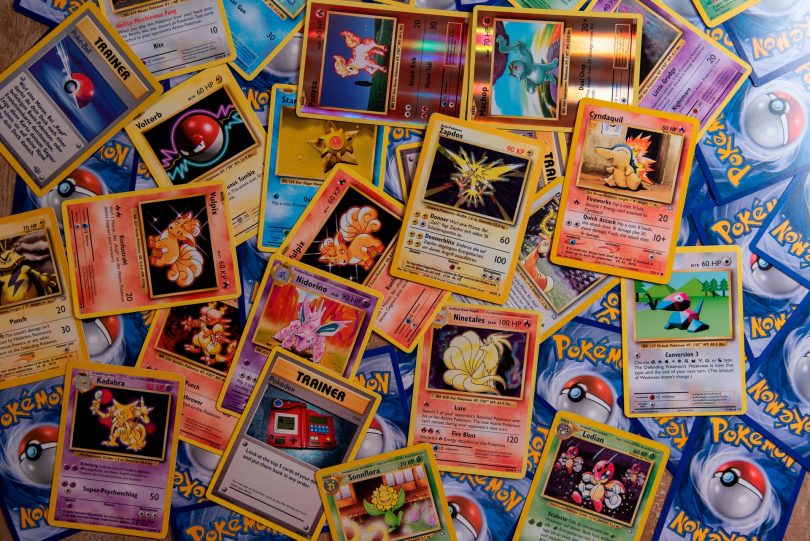

Pokémon cards have hit the headlines recently, with unopened boxes and rare first edition cards selling for spectacular six figure sums at auctions.
The Japanese cartoon franchise first launched the trading card game in 1996, and celebrated its 25th anniversary with the release of a special collection in February 2021.
As the value of the cards skyrockets, now might be the time to reopen those boxes of old toys in the garage to check for any rare gems worth a fortune in today’s booming market. But Pokémon cards are not just about money-making or nostalgia. Collecting the cards and playing the trading card game offers a range of benefits for children and adults alike, and as the hobby continues to increase in popularity around the world, it is clear that Pokémon cards are here to stay.
Are you keen to join the international community and start your Pokémon journey? We have got you covered! Read on for everything you wanted to know about Pokémon cards.
The Original Playground Craze
Pokémon cards were first launched in 1996, capitalizing on the popularity of the Nintendo Game Boy games Pokémon Red and Pokémon Blue released earlier that year. The colourful trading cards were the defining playground craze of a generation of young collectors and gamers.
The first set, known as the Pokémon Base Set, contained 102 cards, including the holographic Charizard, the powerful flying dragon renowned as the most sought-after and valuable of all the characters. There are now over 100 different English and Japanese sets, featuring different selections of the various Pokémon types: Grass, Fire, Water, Lightning, Psychic, Fighting, Darkness, Metal, Dragon, Fairy, and Colourless.
The spectacular international popularity of these sets has made Pokémon the world’s best-selling trading card game, with over 30 billion cards sold.
A Beginner’s Guide to the Pokémon Trading Card Game
The Pokémon Trading Card Game sees two players send their cards into the field to battle, powering their Pokémon’s attacks using energy cards and supporting their team using trainer cards. There are usually six Pokémon cards in play on either side at any one time, with a player putting forward one active Pokémon and leaving five on the bench.
The two active Pokémon launch attacks at each other, as players take turns to try to knock out their rival. Every Pokémon has a certain amount of hit points, which represents how much damage they can take before getting knocked out. If you knock out your opponent’s Pokémon you draw one prize card, and your opponent must replace their downed fighter with one of the Pokémon on their bench. There are several ways to win, but the two main ways are to draw all of your prize cards or knock out all of your opponent’s Pokémon.

Part of the appeal of the Trading Card Game is the wide range of strategies and attacks available to players. Trainer cards can assist in a multitude of different ways, introducing variety to each game. Players rely on the strength and variety of their Pokémon squads to improve their gameplay, adding extra incentive to collectors searching for new cards to add power and diversity to their attacks.
Competition
The popularity of the Trading Card Game has inspired the formation of leagues and competitions across the world.
Pokémon Organized Play (POP) is the game’s official league programme based in North America, organizing competitive tournaments where players can battle local opponents to earn player points, booster packs, and other collectibles. These player points and prizes lead to ranking events, from local and regional tournaments up to the Pokémon World Championships.
11 Reasons to Play: Benefits of Pokémon Cards for Players and Collectors
Pokémon cards offer a wide range of benefits to both players and collectors. While the Trading Card Game helps players develop strategic thinking and basic literacy and numeracy skills, the collecting aspect of Pokémon cards makes it an attractive hobby for a number of reasons. Studies have associated collecting with a series of mental health benefits, and just as earlier generations collected stamps, baseball cards, and beanie babies, an international community are discovering their passion for collecting with Pokémon cards.
Here are 11 ways your passion for Pokémon cards can actually help you:
1. Reduce Stress
We are constantly bombarded with stressful situations, and the COVID pandemic of 2020-21 was particularly stressful for families around the world. Stress impacts both your mental and physical health, and can lead to fatigue, depression, insomnia, and high blood pressure. In today’s stressful world, it is important to find methods to reduce our anxiety and unwind. Psychologists recommend collecting as a hobby for reducing stress, allowing collectors to enter a meditative safe space where they can leave behind their anxieties. What better outlet than the colourful and diverse world of Pokémon cards?
2. Develop Observational Skills
To be the best trainer and collector you need to develop advanced observational skills to recognise the small details that differentiate each card. Collectors become especially mindful of the specific details of their interests, noticing features that would ordinarily escape non-collectors. These advanced observational skills can be translated to other arenas. Could you tell a red-cheek Pikachu from a yellow-cheek? How quickly would you notice if you came across a Rainbow Rare? Pokémon cards will help you sharpen up those observational abilities.
3. Develop Organizational Skills
Playing and collecting Pokémon cards can help improve organizational skills. Card collections require sorting into categories and groups, whether it’s organizing your squad for your next battle, assessing your best options to battle against Electric types, or setting out your rarest cards for an exhibition. Next time you need to organize your research notes for an exam or a project at work, you’ll appreciate the time you spent developing your organizational skills with your Pokémon cards!
4. Strengthen Pattern Recognition
Pattern recognition is the ability to assess and categorize objects quickly, and to recognize common characteristics and patterns. You’ll need these abilities while battling your Pokémon cards and sifting through packs. Collectors become so cognizant of small details that they can recognize fakes, rares, and battle mismatches.
5. Discover New Interests and Awaken a Desire for Knowledge
Exploring the world of Pokémon can lead to an appreciation of new fields of wonder and diversity. Pokémon fans are passionate about the colourful diversity of the world of Pokémon, with a plethora of different characters and types to keep you engaged on your mission to “Catch ‘em all”! Becoming a master of Pokémon cards provides trainers with a confident command of their subject, introducing them to the power of knowledge.
More specifically, an interest in Pokémon could evolve into an appreciation of biodiversity in the natural world. Those that forage for mushrooms and collect rare specimens of minerals or fossils derive similar pleasure and rewards from their hobby as Pokémon card enthusiasts. All of these interests involve adventure, discovery, and the pursuit of new knowledge. Next time you wander through the forest with a young Pokémon fan, remind them that during mushroom season the forest floor comes alive with a diverse array of different types – some exotic, some edible, some dangerous!
6. Develop Social Skills with the Pokémon Community
Pokémon fans can find friends with a shared passion all around the world. Discovering a common interest with others helps young people develop social skills and establish friendships. These friendships might be local, trading cards with your neighbours or schoolfriends, or international, connected in a diverse and active online community sharing tips and stories about their cards in forums, on social media, and on YouTube. Lasting friendships often sprout from shared interests, and the world of Pokémon welcomes new fans to a large and supportive community.
7. Develop Trading and Negotiation Skills
Would you swap a Weedle for a Machamp? How about a Blastoise for two Trainer cards? Depends on what type of Trainer cards, of course!
Trading Pokémon cards provides an introduction to negotiation skills which could later translate to the world of work. No one catches them all without trading, and you’ll need to develop strong negotiation skills to make it to the top.
8. Develop Critical Thinking and Problem-Solving Skills
Playing the Pokémon Trading Card Game will put your critical thinking and problem-solving skills to the test, forcing you to think strategically to outwit and defeat your opponent’s Pokémon. What is the best style of defence against a powerful Fire Pokémon? Where are Venusaur’s vulnerabilities? And what should you do if your opponent plays a Battle Compressor Trainer card? Thanks to the wide variety of card types and styles of attack, you will need to stay alert and think on your feet during battle.
9. Improve your Memory
There are over 10,000 unique Pokémon cards. With so many different features and combinations, the world of Pokémon cards can help you strengthen your powers of storing and recalling large amounts of data and information. Successful Trading Card Game players can tell you Mewtwo’s HP and how much damage Gengar causes with his Dark Mind attack. While these nuggets of information might only be useful while battling Pokémon, the process of developing your memory and your ability to store and use data will help you with other tasks such as studying for your exams or compiling your shopping list!
10. Creativity
Pokémon cards can stimulate creativity among players, traders, and collectors. The colourful cards are visually stimulating and invite players to make connections between elemental types and different sets, inviting them to be creative. And the beautiful card designs might inspire a young artist to take up the paintbrush!
11. Basic Literacy and Numeracy Skills
Players will develop basic literacy and numeracy skills while playing with Pokémon cards. Each card features a description of the Pokémon, with details about their unique characteristics and statistics about their attacks and Health Points. While reading about their Pokémon and adding and subtracting Health Points during battles, players will be working on their reading comprehension and numeracy skills without even knowing it. Pokémon makes learning fun!
Cards as Commodities
Pokémon is the highest-grossing media franchise of all time, and the cards have soared in value during the COVID-19 lockdown.
eBay reported that sales of Pokémon cards in the USA increased by 574% between 2019 and 2020, and a rare first edition set recently sold for more than $400,000 (£282,000).
“Values for Pokémon has absolutely skyrocketed in recent years. It’s an absolute global phenomenon and there are many factors at play here – nostalgia perhaps, some people now with more resources than when they were children using that ability to acquire,” Alex Keller, a spokesman for Richard Winterton Auctioneers, told the BBC.
YouTuber Logan Paul bought an unopened box of first edition cards for $250,000 (£180,000), and hosts live pack openings on his channel. 300,000 viewers tuned in live in October 2020, while a video of his February 2021 pack opening reached 4.5 million views within a month.
The value of Pokémon cards depends on their condition. The PSA (Professional Sports Authenticators) grading provides the industry standard for independent verification of authenticity and condition, with the top grade of PSA 10 reserved for cards in pristine condition. A first edition Charizard PSA 10 represents the holy grail for Pokémon card collectors, but a Charizard PSA 7 or 8 might still fetch a big sale price at auction.
5 of the Most Valuable Pokémon Cards
Venusaur
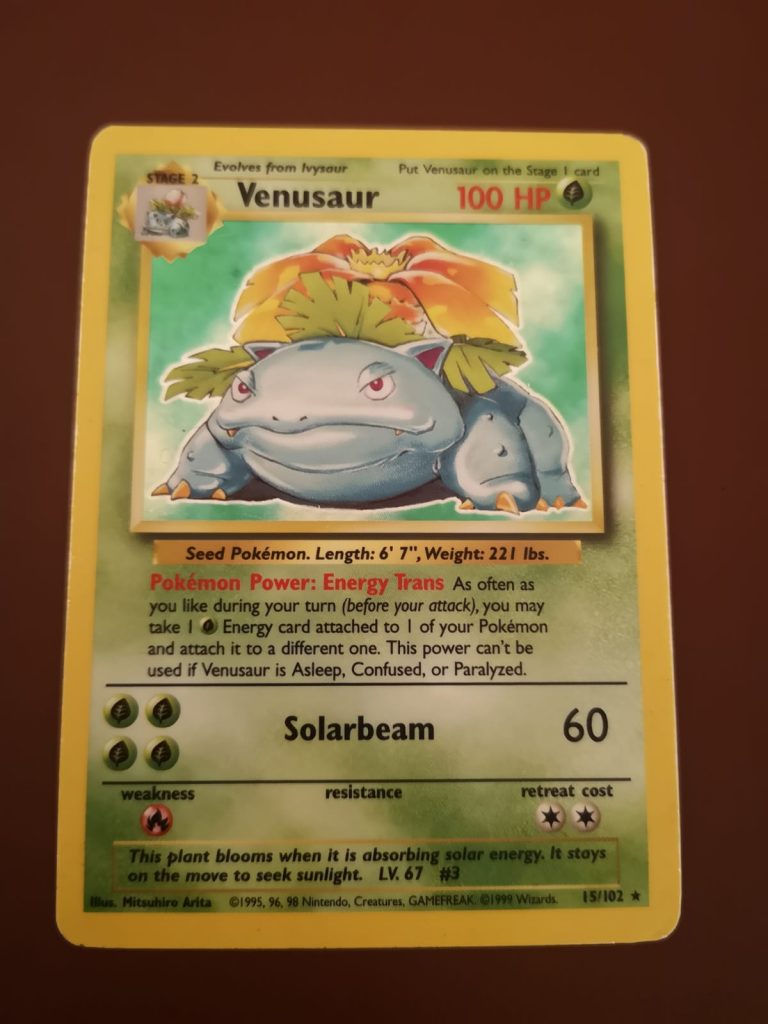
This first generation grass Pokémon is an original favourite and one of the rarest base set cards available.
First edition versions of the card, printed with a circular black “1st Edition” stamp on the left hand side to confirm that they were produced during the first print run, sell for $5,000-10,000.
The Illustrator Card
Created for the winners of a Pokémon illustration competition run by Japanese manga magazine CoroCoro in 1997, there were only 39 copies of this card printed, making it one of the rarest of all time. Several are now lost or destroyed, and there are only half a dozen confirmed to still exist. On the rare occasion that one of these cards comes onto the market they sell for huge prices, over $75,000. In July 2020 Heritage Auctions sold an Illustrator Card for $90,000.
Blastoise
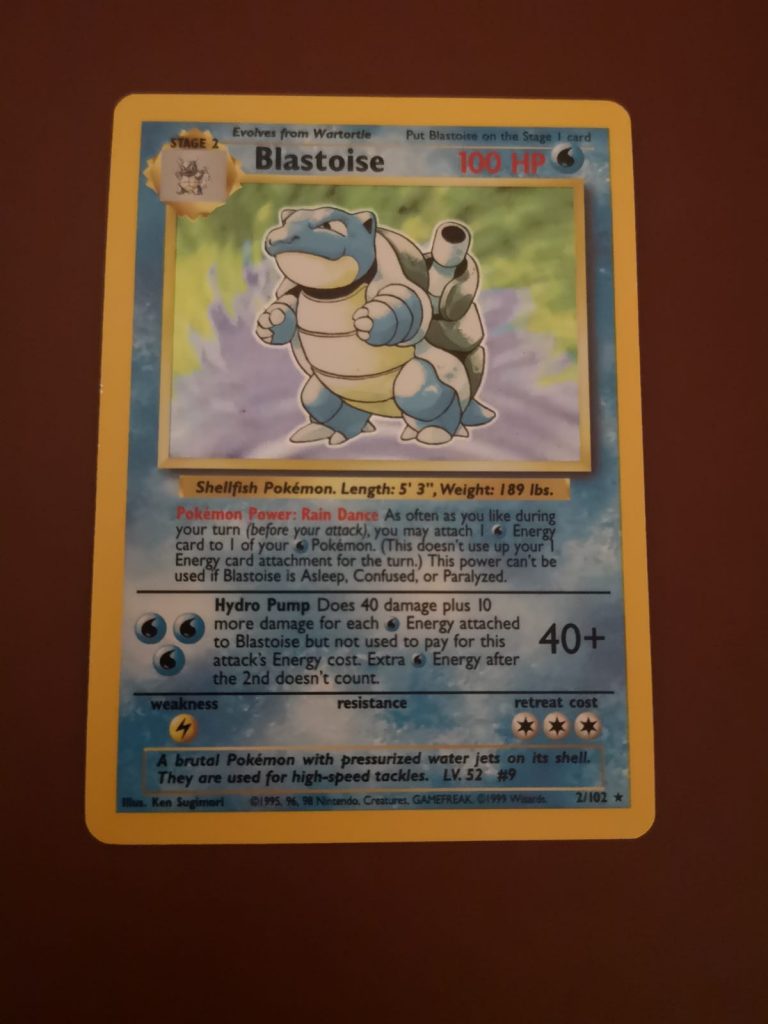
Another Generation 1 Pokémon and the game mascot of Pokémon Blue, Blastoise is one of the market’s favourite cards, with 1st Editions selling for around $20,000 at auction. A ‘Shadowless’ Base Set Blastoise has sold for $50,000 (£36,000). Shadowless cards are a rare set produced in the original print run of the game, and can be identified by the lack of a drop shadow around the frame of the Pokémon.
An exceptionally rare version of Blastoise became the most expensive Pokémon card ever in January, when it was sold by Heritage Auctions for $360,000 (£260,000). The Blastoise was one of just two cards that Wizards of the Coast printed to pitch the trading card game to Nintendo – the Adam and Eve of Pokémon cards.
Shining Kabutops
Shining cards were produced for the Neo Revelation and Neo Destiny expansions, and a mint condition Shining Kabutops will fetch over £1,000 at auction. These special cards can be identified by a three-star rarity grading in the bottom right, and by the distinctive holographic Pokémon designs.
Charizard
The most famous of all Pokémon cards, shiny Charizard is the holy grail for most collectors. Shadowless versions of the card in mint condition sometimes sell for hundreds of thousands at auction, and even a regular Charizard with a good PSA rating can fetch over £1,000.

Conclusion
The original Pokémon generation of the 1990s are now becoming parents and passing down their childhood passion to their children. As the Trading Card Game expands, recruiting a new generation of Trainers to take up the challenge, the popularity of this world of wonder shows no sign of slowing down.