
Scrabble has reported that lockdown boosted sales of the game in Britain by 51.2% in 2020. Part of the current craze for traditional stay-at-home activities, the classic word game has been a family favourite ever since its invention in the 1930s. It is estimated that 50% of UK homes and one-third of American homes have a Scrabble set, and the game is played in more than 120 countries in 33 different languages. What makes it so popular worldwide, and why should you and your family get involved? Read on for a guide on how to play, top tips to become a Scrabble superstar, a series of potential benefits of the game for young and old alike, a tour of its weird and wonderful history, and some fun facts that you’d never expect. This is everything you wanted to know about Scrabble.
Scrabble Classic Board Game

How to Play
Scrabble is a game for 2 – 4 players.
You will need: a game board, 100 letter tiles, a letter bag, and four racks.
In Scrabble, players earn points by creating words with letter tiles and placing them on a grid. Each letter has a different point value, and some grid spaces have special multiplier functions. The player with the highest score at the end of the game wins!
Step 1: Draw tiles to see who goes first
With all 100 letter tiles mixed up inside the pouch, each player draws one tile, without looking inside the pouch, to see who goes first. The player with the letter closest to ‘A’ plays first. Return all the letter tiles to the pouch and mix them up.
Step 2: Pick your seven starting tiles
Each player now draws seven new letter tiles from the pouch and places them on their rack. Make sure you don’t look inside the pouch when you’re drawing new letters – that’s cheating! – and position your rack so that your opponents can’t see what letters you have.
Step 3: Take the first turn
The first player begins the game by combining two or more of their letter tiles to place a word that crosses the star square at the centre of the board, either horizontally or vertically. Diagonal words are not allowed.
Step 4: Calculate your score
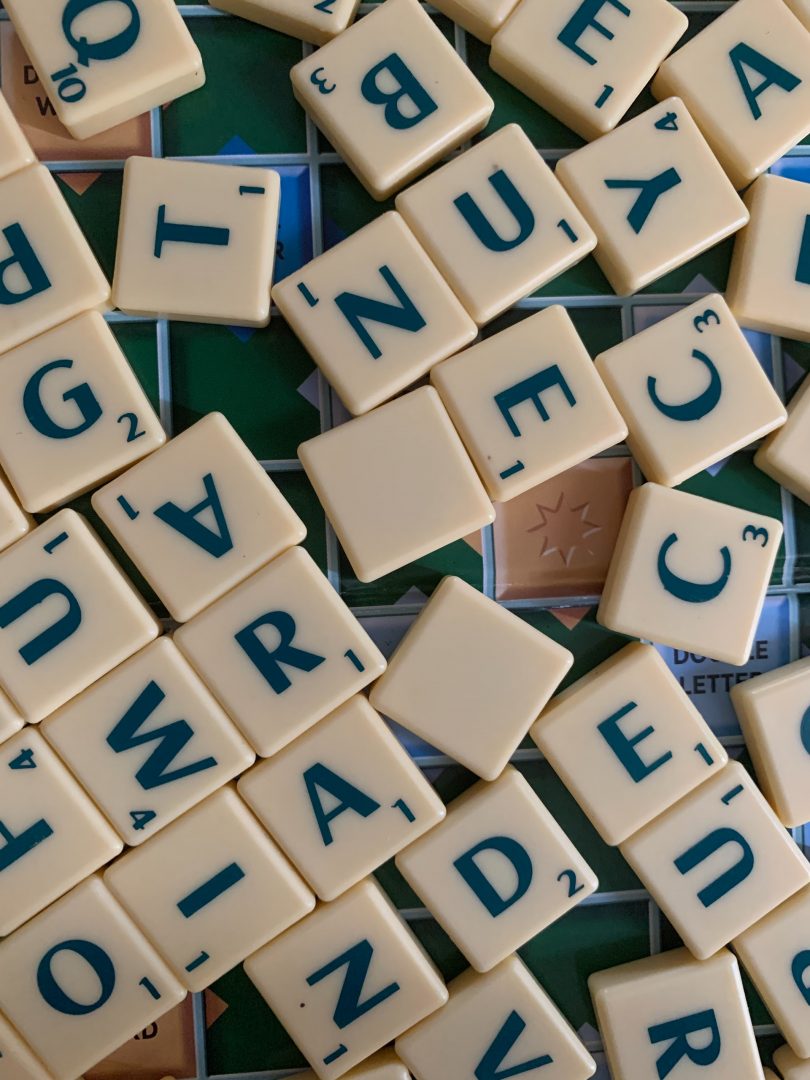
Count your score by adding up the numbers on the bottom right. Point values range from 0 points for a blank tile to 10 points for the letters ‘Q’ and ‘Z’.
Pay attention to the multiplier squares on the grid – you can double or even triple your letter and word scores by placing words over these special squares. For example, the centre tile is a pink square, which automatically gives the opening word double points.
Multiplier Letter Squares: A light blue square doubles the score of a letter placed on it; a dark blue square triples the letter score.
Multiplier Word Squares: The score for an entire word is doubled when one of its letters is placed on a pink square; it is tripled when one of its letters is placed on a red square. If applicable, include premiums for double or triple letter values before doubling or tripling the word score. If a word is formed that covers two premium word squares, the score is doubled and then re-doubled (4 times the letter count), or tripled and then re-tripled (9 times the letter count).

Letter and word premiums count only on the turn in which they are played. On later turns, letters already played on premium squares count at their standard value.
Use a pen and paper to keep track of the scores for each player.
Once they have placed their word, players complete their turn by replenishing their rack with new letters to ensure they have seven letter tiles at all times.
Step 5: Proceed with play clockwise
Play continues in a clockwise direction for the next player to take their turn.
The second player, and then each in turn, adds one or more letters to those already on the board to form new words. All letters played on a turn must be placed in one row across or down the board, to form at least one complete word. If they touch other letters in adjacent rows, those must also form complete words in a crossword fashion. The player gets full credit for all words formed or modified by their turn. So if you place a letter tile ‘s’ on the word ‘game’, you score all the points for ‘games’.
Once a word is played, it cannot be removed or moved.
During each turn, a player can decide to place a new word on the board, exchange their tiles, or pass.
If a player decides to exchange tiles, they must replace them with an equivalent number from the pouch. They cannot do anything else on that turn.
Each pouch contains a couple of blank tiles. These are joker tiles, and can be used to represent any letter of a player’s choice. Blank tiles do not score any points, and they remain the same nominated letter for the rest of the game.
If a player uses all seven of their tiles in one turn, they win a 50-point bonus to add to their score!
Players can challenge their opponent’s words. If the word cannot be found in the dictionary, the challenged player losers their turn. If the word is found in the dictionary, the challenger loses their turn.
Step 6: Ending the game
Play concludes when all 100 letters have been picked from the pouch and a player has used all of their tiles, or when no one can create any more words.
The final scores are then calculated for each player by adding up all of their turns and subtracting the sum of any unused letter tiles left on the rack. If one player has used up all of their letters, add the sum of everyone else’s unused letters to their score.
The player with the highest final score wins, becoming ‘Scrabble champion’, and then proceeds to dance around the room (this step is optional)!
Top Tips for Beginners
Prioritize the multiplier squares on the grid. If you want to win, high point scores are more important than long words. A skilful triple word score could win you the entire game!
Make multiple words at the same time, either parallel to words already placed on the board, or via plurals or adaptations. ‘S’ is the most valuable tile for this strategy – you can put it on the end of so many words and collect the points again.
Always look for options parallel to words already on the board. You get points for every word you form, so although a word played alone might have a low score, the bonus from the words formed in conjunction with the parallel word can significantly increase your score.
Try to find a “Hook”, transforming existing words on the board by adding a letter at the beginning or end. For example, turn RUSH into CRUSH, INCH into FINCH, or HOUSE into HOUSED.

Bananagrams
For younger players finding Scrabble a little too challenging, Bananagrams can provide an ideal introduction to this family of word games.
Simple and addictive, Bananagrams requires no pencil, paper, or board, and comes in a fun banana-shaped pouch that’s perfect for gaming on the go.
Bananagrams are letter tiles with no point values. Here’s how to play with them:
- Turn all the tiles face down in the middle of the table.
- Each player takes the same number of tiles for their personal pile, keeping them face down. For up to 4 players, take 21 each. When playing with 5-6 players, take 15. With 7 or more, take 11 tiles each.
- Leave the remainder of the tiles face down in the middle – they are the ‘bunch’.
- On the count of 3, players shout ‘Split!’
- Each player flips their tiles and races to make their own word grid.
- When a player has used all their letters they must shout ‘Peel!’
- If a player wants to swap out a difficult letter they can shout ‘Dump!’ and discard it into the ‘bunch’, but they must pick up 3 more from the bunch at random to replace it.
- Play continues until there are fewer tiles than players.
- At this stage, when someone finishes their grid, they shout ‘Bananas!’
- Their opponents inspect their grid. If they have spelling mistakes, proper nouns, or made-up words, they are a ‘Rotten Banana!’ and must return their tiles to the bunch and start again.
- But if your grid checks out, you win, and you are ‘Top Banana’!
7 Reasons to Start Playing: The Benefits of Scrabble for All Ages
1) Improve your language skills and expand your vocabulary
There are over 170,000 words in the Oxford English Dictionary. Toddlers usually develop a vocabulary of around 20 words, and by the time they reach the age of 5 they will know on average between 2100 and 2200 words. The average educated adult knows about 20,000 words. Meanwhile, the average top level Scrabble player knows about 120,000 words!
This classic word game evidently helps players expand their vocabulary, crucial for children at every stage of development. At a time when our use of language can be restricted by the character limits of a Tweet or text-speak on the go, Scrabble provides an opportunity to discover new words and visualise the construction of languages in new ways. For example, an ‘e’ is a more useful letter tile than an ‘o’, because it is more commonly used in English words. But a combination of ‘d, o, o, w’ is better than ‘d, e, o, w’ as there are so many words that end in ‘wood’.
Language is powerful, and Scrabble can help you unlock its power. A child with a wider vocabulary will have an advantage at school, becoming a stronger communicator, a more creative writer, and a more confident speaker for classroom presentations and other challenges. Inspire a young wordsmith today!
2) Develop your numerical abilities
It isn’t all about words – Scrabble is also a numbers-based game, helping players improve their maths. Calculating your score can be challenging, especially when you hit a multiplier square. Young players will learn about chance and risk as they decide whether to exchange their tiles, leave a triple word square exposed, or go for a bingo bonus!
3) Increase your spatial awareness and become a creative problem solver
Creating words out of your letter tiles will test your problem-solving abilities, especially if you happen to have a ‘Q’ and no ‘U’! In addition, surveying the board for the best point scoring opportunities will help you improve your spatial awareness. These skills will be transferrable to a wide range of areas, from the classroom to the boardroom and beyond!
4) Scrabble is a game for everyone!
Among the competitors at the prestigious Australian Scrabble Championships in April 2021 were whizz-kid Jeffery Lam and great grandmother and reigning champion Rene Chelton! What other national championships could you find an eight-year-old competing against an 87-year-old?! Scrabble is clearly a game for all ages, making it an ideal activity for family bonding.
A game of SCRABBLE can bring the whole family together to learn from each other, exchanging words, stories, and spellings. Create an all-time family leaderboard to record the highest scoring words and final scores at your table – players will compete not just for each game but for the prestige of appearing at the top of the all-time leaderboard and earning a place in family history!
5) Practice in new languages
Scrabble is a fun way to practice new languages. Why not try using your new French vocabulary learned at school? Learning Spanish? For your next Scrabble game, Spanish words count double!
Some players experiment with new rules to customise the game to their own interests. Star Wars characters, Harry Potter words, and the Dothraki language from Game of Thrones have all made for popular themes.
Become a language wizard with Scrabble, whether it’s in English, Spanish, or Dothraki!
6) A War of Words: Introduce some friendly competition to your family game night
Scrabble will ignite the competitive spirit of every player! The board’s multiplier squares and the tile picking process at the end of each turn introduce an element of luck that gives everyone a chance to win. As well as competing for the top score in a given game, players are also in a constant competition with themselves, always having the opportunity to beat their personal record and set a new high score. Why not try playing in teams to develop your cooperative skills? Parents versus kids… The ultimate rivalry!

7) Mindfulness
Even before there was a global pandemic to contend with, the stressful nature of modern life had prompted a global trend for mindfulness activities. Scrabble will make an ideal addition to your mindfulness routine. Lose yourself in the world of letter tiles and triple word scores and forget the tensions and stresses of the daily grind!
Fun Facts You Never Knew About Scrabble
Held every two years since 1991, the World Scrabble Championship is the most prestigious title in competitive English-language Scrabble. The reigning world champion is Nigel Richards, known as the ‘Tiger Woods of Scrabble’. In 2015 Richards won the French World Scrabble Championships, despite not speaking a word of French, having memorised the entire French Scrabble dictionary in nine weeks!
Scrabble is constantly evolving, with new words added and disallowed every year. Among thousands of new words incorporated into the official version in recent years include “Bitcoin”, “emoji”, and “sheeple”.
One of the most popular new words is “qi”, the life force in traditional Chinese medicine, finally ending the nightmare of getting stuck with a ‘q’ without a ‘u’!
5 high scoring words
Word: Oxyphenbutazone
Score: 1,778
Definition: a defunct nonsteroidal anti-inflammatory drug (NSAID).
It has never actually been played in a game, but in theory this is the highest scoring possible word!
Word: Muzjiks
Score: 128
Definition: A pre-1917 word to refer to a Russian peasant
Fun fact: Jesse Inman played this as his opening word in 2008 to beat the record for the highest-scoring opening word.
Word: Za
Score: 20
Definition: Slang term for pizza
Fun fact: Za and Qi are the highest scoring permissible two letter words on the SCRABBLE board.
Word: Quixotry
Score: 365
Definition: Derived from the character Don Quixote, quixotic action of thought
Fun fact: A carpenter broke the record for highest score in SCRABBLE by playing this word in 2006.
Word: Syzygy
Score: 93
Definition: A roughly straight-line configuration of three or more celestial bodies in a gravitational system.
Fun fact: There are only 2 Y tiles in Scrabble so a player would need a blank tile to make this word.

The Hard-Knock History of Scrabble
Scrabble was born in America during the Great Depression, invented by unemployed architect Alfred Mosher Butts, whose birthday is now celebrated as National Scrabble Day. The game was designed to combine anagrams and crossword puzzles with the elements of chance and skill that made card and dice games so popular. Originally named Lexiko, the game was refined in the 1930s and 1940s to become Criss Cross Words.
Much like record labels dismissed The Beatles and movie producers turned away Marilyn Monroe, all of the established entertainment companies of the day missed the ingenuity of the game and rejected Butts’ idea.
The game was redesigned in the late 1940s after Butts went into partnership with entrepreneur James Brunot. By 1948 the pair had trademarked ‘Scrabble’. But success came very slowly.
Legend has it that the Scrabble craze was sparked in the early 1950s after the intervention of the president of Macy’s department store, who discovered the game while on holiday. Introducing the game to his store, Scrabble soon became the hit craze of the day, and its popularity has endured.
Today there are digital versions by EA Sports and other app makers, inspiring a new community of Scrabble lovers online. But nothing beats the table-top board game for a night of family fun!
Scrabble Classic Board Game