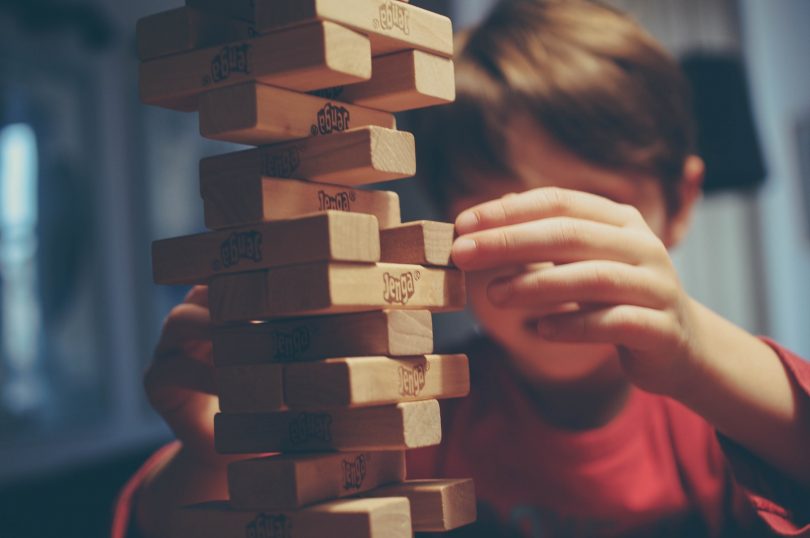

“JENGA!” This loud call, followed by a clattering of building blocks as they scatter across the table, is familiar to families all over the world.
The classic block-building and tower tumbling game has remained a family favourite ever since its launch in 1983. In fact, Jenga is the third most popular game in the world, behind only Monopoly and Scrabble in units sold.
What makes it so popular, and why should your family join in the fun?
As an intuitive, physical game of action and skill, Jenga is unique among the staple activities of family entertainment. You don’t need to learn any complicated rules. You don’t need any special equipment. And you don’t need any prior knowledge or experience. Jenga is for everyone, for players of all ages and skill levels! Get building, get active, and prepare for lots of fun and lots of tower tumbles!
Although it might look simple, there is a lot more to this classic than first meets the eye! We’ve got it all covered for you, so read on for everything you wanted to know about Jenga!
How to Play
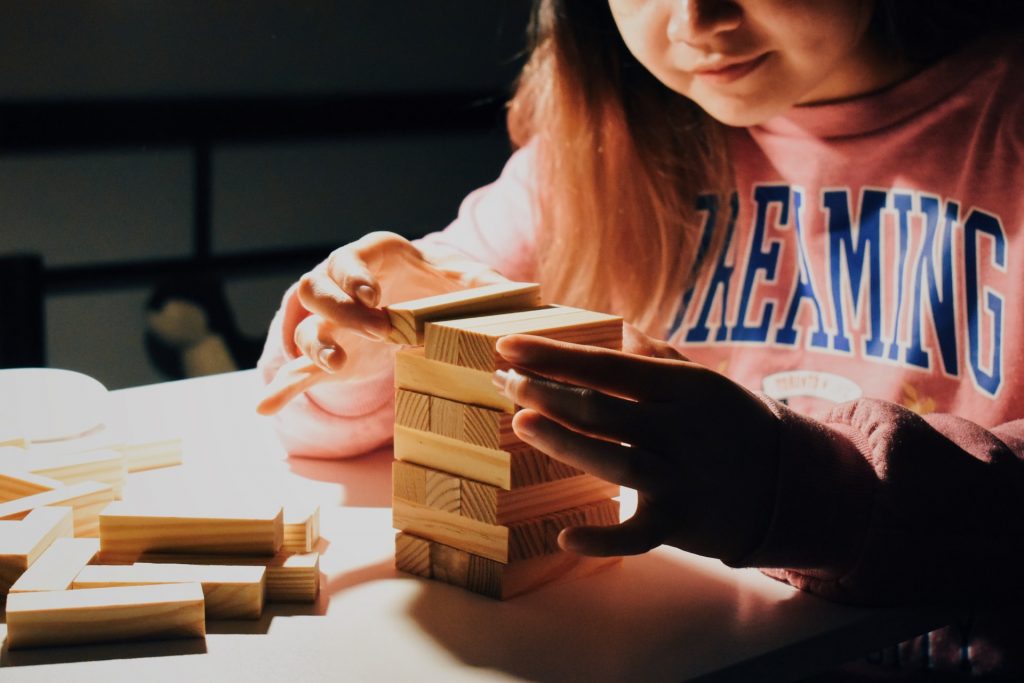
- Begin by building a vertical tower of Jenga blocks by stacking three side-by-side blocks in each row.
- Each new row is turned 90 degrees from the block below it, so that every row is perpendicular to the level below it.
- The youngest player begins. A turn consists of a player removing a block from the tower and placing it on top to form a new row.
- You can only use one hand at a time when touching the tower of the Jenga blocks.
- A block can only be removed from below the highest completed level.
- A turn ends either 10 seconds after replacing the Jenga block on the top of the tower or when the next player touches the tower.
- Players continue to remove and stack the blocks until the tower becomes dangerously unstable.
- Eventually the tower will fall.
- The player who last stacked a block successfully wins the game!
- The player who caused the tower to fall loses, and must rebuild the tower to start the next game!
History
Jenga was born in Africa, and the name comes from the Swahili term “Kujenga”, which means “build”. Inventor Leslie Scott grew up in East and West Africa, attending schools in Tanzania, Uganda, Kenya, Sierra Leone, and Ghana. Jenga evolved from a game she played with her family in the early 1970s, using wooden building blocks purchased from a sawmill in Tahoradi, Ghana. Scott launched the game at the London Toy Fair in 1983, and Jenga immediately caught the public imagination, selling 15 million copies in 1984!
Reasons to Start Playing Jenga!
1) Become Better at Building!
In order to succeed at Jenga, players must learn to become skilful builders.
This simple game can teach us a lot about the complex world of structural engineering. All structures are vulnerable to the same forces that can topple a Jenga tower. Balance, tension, compression, loading, rotational motion – all of these complex structural engineering terms come into play during a game of Jenga. Meanwhile, an accidental bump of the game table can represent a micro version of a catastrophic earthquake!
Watch your children intuitively learn the fundamental principles of foundational stability and logical building techniques using nothing but a set of wooden blocks… let gravity do the rest!
2) Improve Your Coordination
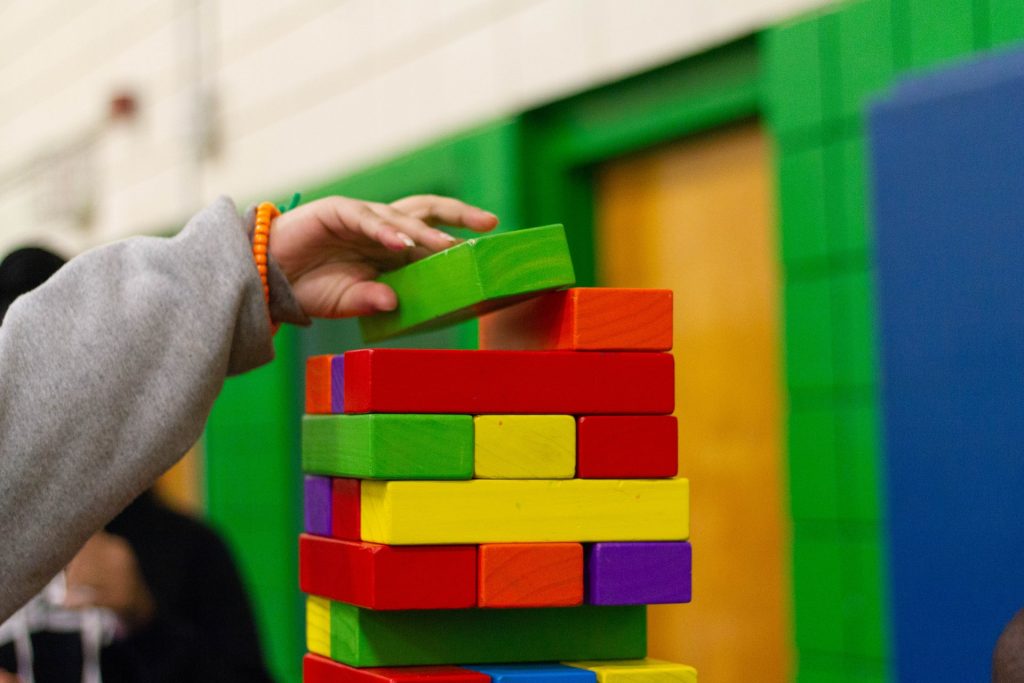
Jenga is the ultimate game of dexterity and coordination, requiring the steadiest of steady hands to tap, shift, remove, and replace the wooden blocks of the tower.
The game can be a useful tool for helping very young children develop their fine motor skills – the actions that use the smallest muscles in the hands and fingers in coordination with the eyes. These skills will give them a head start as they learn to write, grasp small objects, tie their laces, and fasten their coat buttons. For older players, Jenga provides a challenging test of manual dexterity, enhancing abilities to perform complicated physical actions quickly and precisely.
3) Develop Strategic Thinking
Jenga demands critical thinking. Each player must analyse the tower, assessing its structural integrity, before taking their turn at removing and replacing a block. Not only are they looking for a “safe” block to prevent the tower from falling – they are also attempting to make their opponent’s turn more difficult by shifting strategic blocks.
Stimulating this kind of strategic thinking in young players will provide a major boost for their future success at school and in work.

4) Learn Patience!
Kids can struggle to wait their turn without feeling anxious, and Jenga can help them to develop patience.
Encourage them to remain active while waiting for their next turn – they could spend the time working out their next move, or studying their opponent’s strategies and monitoring the changing structural dynamics of the tower.
Patience is a virtue, as the old saying goes, and Jenga can help your children learn it while having fun.
5) Hone Social Skills
Although the game is essentially played solo, Jenga involves a wide range of social interactions.
As there are no barriers to playing, Jenga is a great way to make friends. You can challenge anyone to a game, and once you get going, the unique challenges of building the tower and preventing it from falling will get everyone talking and laughing together!
Learn to cooperate to build the biggest tower! Learn to deal with the pressure of a tricky block pick on a wobbly tower! And most importantly, learn to win and to lose gracefully!

Products
There are variations on the classic Jenga set to suit every interest, with a wide range of branded versions dedicated to sports teams, movies, video games, and famous characters. From miniature to giant-sized versions, from toddler-friendly to adult games, and from Hello Kitty to Super Mario, there’s a Jenga tower for everyone!
The Giant Tumble Tower by Jaques London can reach over 5ft tall! Play it in the garden or at the park, but watch out underneath when it tumbles!
Jenga Pink Girl Talk is a cult classic, with players challenged to answer questions before they stack blocks on top of the tower to complete their turn. Here is a sample of the questions:
What is your worst fear? Describe one of your secret talents? What do you want to be when you grow up? If you had one wish, what would you wish for? Name someone you have a crush on right now. What country would you like to visit? If you were an animal, what would you want to be?
So you might discover more about your friends than you ever knew before! Jenga Pink Girl Talk has proved popular as the perfect girl’s party companion.
Animal Tumble is designed for educating kids. Players roll the dice, which feature a different animal on each face, and must choose a block that matches the animal on the dice you rolled. Animal Tumble includes a hedgehog, a ladybird, a cow, a caterpillar, a snail and a bumblebee.
The brightly coloured wooden blocks and designs stimulate children to recognise and name the animals, inspiring curiosity about the world around us.
Other popular versions are dedicated to the world’s favourite brands, board games, movies, sports teams, and video games, including:
Fun Facts about Jenga
- The world record for the highest Jenga GIANT tower is 44 levels!
- The Guinness World Records reports the fastest time to build a stable JENGA tower 30 levels high within the rules of the game is 4 min 4 sec, set by Dan Mogan and Anastasia Carpanzano of the USA at the Tower Bridge Exhibition, London, UK, on April 1, 2005.
- Jenga blocks are not identical! They are engineered to have subtle differences in dimensions to make their construction less stable. Each block is slightly different in size and weight, so no two games are ever the same!
- Auldin Maxwell is a Jenga master and Guinness World Record holder! He recently broke his own record by stacking 1400 Jenga blocks on one single vertical Jenga block! Read about his inspiring story here, and watch him action on YouTube.
Auldin shared a secret tactic he uses while attempting his record stacks:
“Listening to music during my attempt makes me concentrate better and helps the time pass. My favourite song to listen to while stacking is ‘Maple Leaf Rag’ by Scott Joplin from 1899. Because I am on the autism spectrum, I like listening to it over and over and it stays on repeat.”
Conclusion
The beauty of Jenga lies in its simplicity. Anyone can play anywhere, and the teetering tower never fails to make its builders fret, flinch, and laugh when it crashes!
As we have seen, there is more to Jenga than first meets the eye, and it can help teach young players important skills of building, coordination, strategic thinking, patience, and socialising. Bring the whole family together for an action-packed game of block-building and tower tumbling. And you never know – you might inspire a budding architect!