
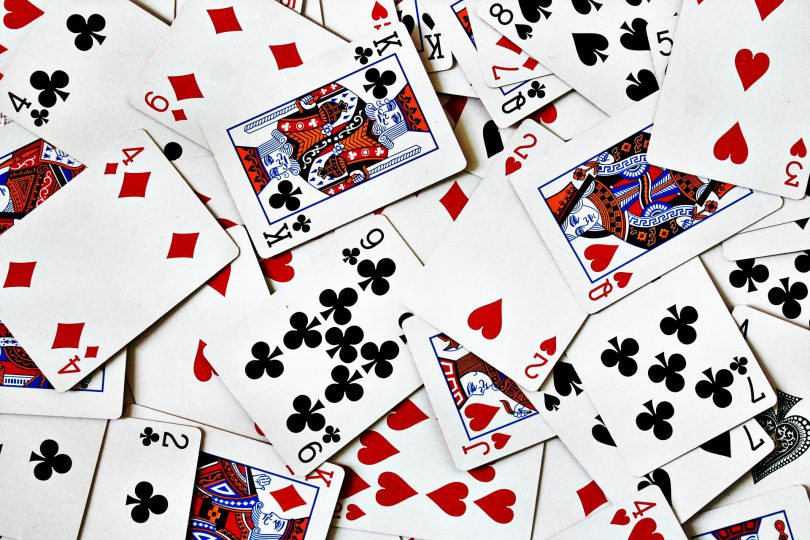

With families looking for ways to pass the time during the COVID pandemic, the trusty deck of playing cards has re-emerged as an unexpected lockdown companion.
Cheap, versatile, and fun for every generation, playing cards offer a wide range of games and activities to suit players of all ages and standards, from absolute beginners to seasoned card sharks. And that’s not to mention the powerful appeal they hold for magicians, psychics, collectors, and historians.
But where to begin? We have compiled this guide to help you get started, explaining the benefits of playing cards, introducing you to some of the most popular games and activities, and taking a whistle-stop tour of the long and colourful history of the standard 52-card deck.
10 Reasons to Pick Up a Deck of Playing Cards:
1) Go back to basics for a digital detox
The resurgence of playing cards is part of a wider trend towards the classic staples of family entertainment, from board games and jigsaw puzzles to Scrabble and Trivial Pursuit. With our smart devices dominating every aspect of our daily lives, these table-top activities are the ideal tools for a “digital detox”, as increasing numbers of families search for something that will bring them together to relax and bond, allowing time to give the mind and the eyes a rest from screens. After a long day of online learning or conference calls, a deck of playing cards can provide an engaging distraction from screens.
2) Play anytime, anywhere!
Portable and inexpensive, a deck of playing cards is the ideal travel companion, perfect for all occasions. Play anytime, anywhere, whether it’s around a campfire, in the car, at the dinner table, or on the beach. Try a deck of waterproof playing cards if you’re worried about them getting wet!

3) Have fun with all the family
Playing cards are the ultimate family fun, popular with every generation. There are few activities other than playing cards that could engage a five-year-old and a ninety-five-year-old, and there are games to suit every age and ability level, as shown in our guide. The familiarity of the standard 52-card deck will help grandparents feel confident in taking part and teaching their family how to play their favourite games – their experience and knowledge is a major asset in the world of card games. But children are quick learners, so don’t bet against the grandchild emerging victorious! Whoever wins, playing cards can bring the whole family around the table to spend some quality time together.
4) Learn to socialize and play fairly
Card games involve a wide range of social interactions, including observation, conversation, and negotiation. The social benefits of playing cards are especially important for both younger and older players.
Games like Rummy, Cheat, and Poker require players to read the reactions and body language of their competitors to gain an advantage, and young players can develop emotional intelligence while having fun and developing confidence. They will also learn how to win and lose games with decorum, even if this takes a bit of time to master!
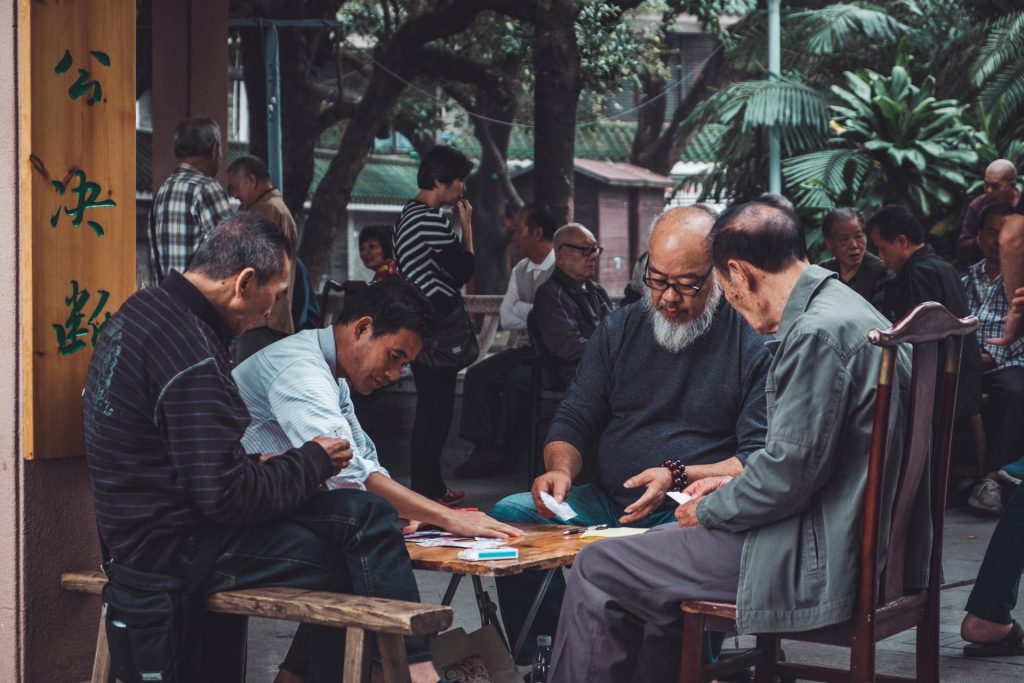
For older players, cards can provide important opportunities for social intercourse. Card games form the centre of communal groups around the world, fostering gatherings and social institutions equivalent to bridge clubs in the UK. Team games like Bridge, Kemps, Nerts, and the Spanish game of Mus encourage collaboration and friendly competition, providing a platform for players to make connections and build relationships with teammates.
5) You can play solo
Yes, card games are a great social activity. But if you haven’t got anyone to play with, there is a wide range of activities that you can try as a solo player. Solitaire and Klondike are variations of the same game, requiring players to place cards in specially ordered stacks. You start with seven piles of cards, randomly assigned, and the goal is to create 4 new piles, separated by suit, and organized in order from Ace to King. The game has become a cult favourite and a popular mindfulness activity.
Or how about learning how to create a house of cards? Try this quick lesson on the basics by Guinness World Record-holding card-stacker Bryan Berg.
6) Improve your memory
Studies have shown that playing card games is effective brain training, and can help to prevent age-related memory loss. Remembering the rules, the order of play, the moves of your competitors, and the cards that have been drawn, all while formulating strategies to win, provides a stimulating exercise for various parts of the brain. This is great for players of all ages, whether you’re training your memory to prepare for school exams or keeping your mind active as you get older.
7) Improve your hand-eye coordination and fine motor skills
Dealing, shuffling, sorting, even just holding your hand of cards while waiting for your turn to play – standard card game mechanics train the small muscles in your hands and fingers that are vital for toddlers and pre-schoolers when they start learning how to write. Card games help children develop coordination, control, and confidence, preparing them for everyday experiences at home and at school such as using scissors safely and effectively, holding a pencil correctly, and unfastening buttons and zips. These activities require basic motor skills that can be trained through card games.
For older players, card games can help preserve or rebuild motor skills as part of rehabilitative therapies. All while having fun!
Shuffling cards requires advanced coordination, but once you learn, you have a skill for life! Check out this shuffling tutorial for beginners.
Top tip: Some young players might struggle to grasp a standard-sized card, and some elderly players experience visibility issues with the standard deck. Thankfully playing cards come in all shapes and sizes, from mini to giant!

8) Work on your maths while having fun!
Card games teach children how to work with patterns, sort into sequences, and add and subtract quickly. Kids will build number confidence and develop quick thinking while playing simple games like Go Fish and Snap, and they will develop more advanced mathematical skills as they progress to more challenging games like Rummy, Hearts, or War.
No wonder playing cards are so popular with maths teachers! ‘Make Ten’ is a particular classroom favourite, and you can get started with our quick guide to the game below.
9) Become a strategic thinker
Help kids build a foundation for critical thinking by teaching them strategy through playing cards. Games are usually competitive and fast-paced, and young players will need to develop strategic thinking in order to improve their skills and, eventually, start winning! Encourage them to focus, practice, and think about tactics – the process will teach them invaluable lessons on how to learn new skills effectively.
10) Learn magic!
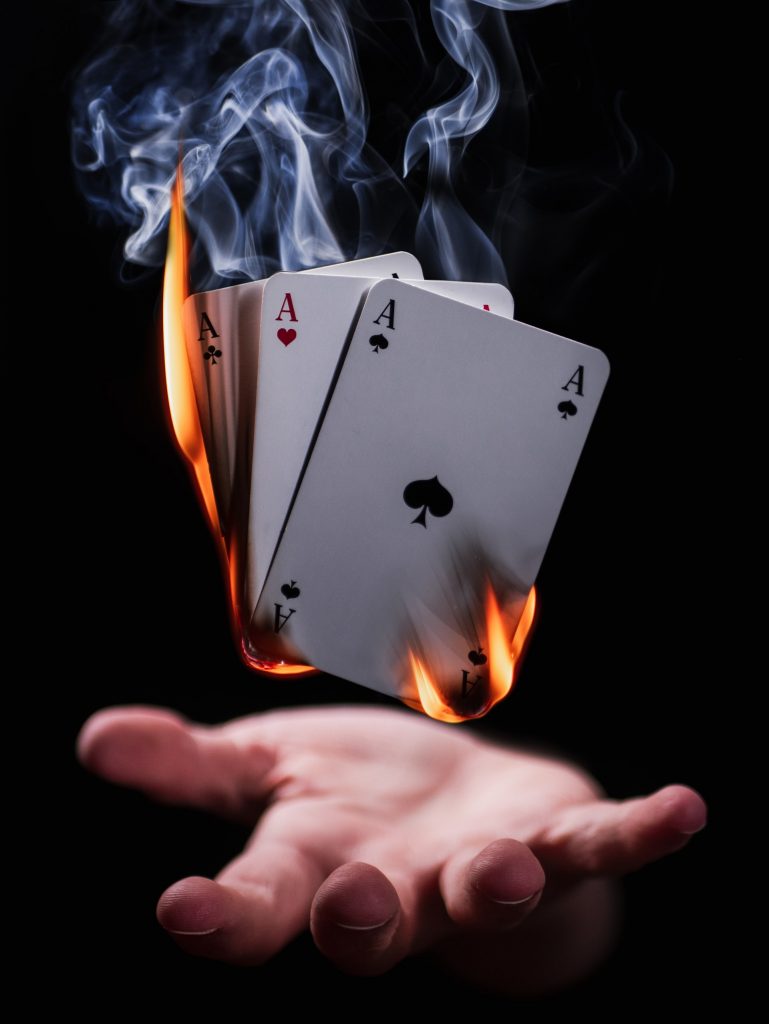
Kids love magic … and all the best magicians began with a deck of playing cards!
Inspire their creativity and boost their confidence by helping them learn some magic card tricks. They’ll make for the perfect performance at your next family get-together.
Check out this tutorial on 3 Easy Card Tricks for Kidsand get ready to amaze your friends and family!
5 great games to get started
Snap
Players: 2-8
Difficulty: Beginner
Perfect for: Young players from the ages of 2 to 10, and anyone who wants a simple and energetic game. Every card shark started out with Snap! Be prepared… it might get loud!
How to play:
The object of the game is to win all 52 cards!
The dealer deals out all the cards to the players, in face down piles in front of them
The player to the dealer’s left begins the game by flipping over the top card of their deck to create a separate face up pile next to them.
Play continues clockwise, with each player flipping over the top card of their face down deck to form a face-up pile alongside.
If any two top cards in any face-up piles form a pair – e.g. two Queens, or two sixes – any player may shout “Snap!”
The first player to do so collects the cards in both piles and adds them to the bottom of their face-down deck.
If two players shout Snap at the same time and you cannot determine a winner, both piles are placed in the middle of the table to form the “Snap Pot”.
If a player shouts “Snap!” mistakenly, with no match on the table, they also place their pile in the middle for the Snap Pot.
If the top card from the Snap Pot pairs with any players top face-up card, anyone may shout “Snap Pot!” and collect all the cards in the middle.
If a player loses all their cards, they are out of the game.
The first player to collect all 52 cards is the winner!
Go Fish
Players: 2-6
Difficulty: Beginner
Perfect for: School age children and players learning the ropes. This game will introduce kids to strategy and negotiation, while teaching them to play fairly. Go Fish relies on honesty, so don’t play with any big cheaters!
How to play:
The dealer deals 5 cards each.
If you are playing with only 2 players, deal out 7 cards instead.
Place the remaining deck in the centre. Spread the cards around, face down, to form a little pond to fish from!
Hold your cards so no one can see them!
The objective is to collect groups of four of a kind – e.g. four Jacks, or four 8s.
The player to the left of the dealer goes first. They ask any other player if they have a specific type of card, but to do so, they must already have at least one of the cards they are asking for.
So if you have a King in your hand you can ask one of your fellow players: “do you have a King?”
If that player has any Kings they must give them all to you.
If they had the card you asked for, you get to go again for another turn.
If a player doesn’t have a card that you asked for, they reply “Go Fish!”
You then “go fish” for the card you are looking for in the pond of face-down cards in the middle. If you find one, you get to go again. If not, the turn passes to the player on your left.
Every time you collect four of a kind you immediately put those four down in front of you, face up. That is called a “book of cards”.
The game continues until someone puts down all their cards or you run out of cards in the fish pond.
At that point, the winner is the player with the most books in front of them!
Make Ten
Players: 1 – unlimited, but each player needs their own 52-card deck.
Difficulty: Beginner
Perfect for: Kids ready to become maths whizzes at school by practising their basic addition and subtraction skills in a fun game!
How to play:
Shuffle your deck and deal yourself 10 cards, face up, in 2 rows of 5. If you are competing against other players, count down from 5, 4, 3, 2, 1, GO! So that everyone starts the opening deal at the same time.
The goal is to “make ten” with as many two or three card combinations as possible.
Face cards (Jacks, Queens and Kings) and Aces are worth 1.
Players create as many addition equations as possible where the sum equals 10. For example, take a 7, a 2, and a King to create a 3-card book.
Play continues until someone reaches the end of their deck. At that point, the player with the most books wins!
War
Players: 2
Difficulty: Beginner
Perfect for: This came has been played in various forms for centuries, and is ideal for young kids just learning how to sit down and play games.
How to play:
The oldest player deals out all the cards.
Gather your cards in a stack, face down, without looking at any.
The goal is to capture all the cards on the table.
To take a turn, both players flip their cards face up in the middle of the table.
Compare the two cards to see which is higher. Aces are high, worth 14, and 2s are the lowest rank.
Quick tip: If you are playing with kids who aren’t confident with numbers yet, get them to count the ‘pips’ – the hearts, diamonds, spades, or clubs, on the card.
The player with the highest ranked card wins both, and places them at the bottom of their face down pile.
Keep playing until there is a draw – two 10s, or two Kings. This means WAR! Players can shout “I declare War!”
When there is a draw, each player deals three new cards face down and one card face up in the middle of the table. The highest card wins them all. In case of another draw, repeat the process until someone wins the entire pile!
If a player runs out of cards during a WAR, they lose!
Keep playing until someone runs out of cards – they are the loser! The player with all the cards – you guessed it – is the winner!
Variations: you can also play with 3 or 4 players – draws only occur if there is a tie with the top ranked cards.
Try leaving the Jokers in the deck – Jokers automatically win any War!
Rummy
Players: 2-6
Difficulty: Intermediate and Advanced
Perfect for: Budding card sharks searching for a classic game of skill and strategy.

How to play:
The aim of the game is to get rid of all your cards by creating “melds”. Melds consist either of three or four cards of the same rank (number), or at least three cards of the same suit in numerical sequence. Aces are low, worth 1.
Dealing the cards: if there are 2 players, each receives 10 cards. For 3 or 4 player games, deal 7 cards each. If there are 5 or 6 players, each receives 5 cards.
Place the rest of the deck face-down in the centre, with the top card face up beside it to create a discard pile.
Play starts with the player to the dealer’s left, and resumes clockwise.
Take your turn by drawing the top card of either the face down or the discard pile.
Can you make any ‘melds’ with your cards? Three 10s? Or an Ace, Two, Three of Clubs? How about four Kings?
If you have any melds, lay them down on the table, face up.
Once a set of cards has been ‘melded’, any other player may lay off additional matched cards to it, even if they weren’t the original melder. So if someone has laid three Kings, and you have a King, you can discard it to that pile on your next turn.
When the face down pile runs out, the discard pile is turned over to form a new main deck.
The winner is the first to lay off all their cards. The losing players gift the winner points, equal to the value of the cards left in their hand. Court cards – Jacks, Queens, and Kings – count 10, Aces 1.
Usually several rounds are played, and the first to reach an agreed total is the winner. Try 250 as a starting total.
Weird and wonderful facts about the 52-card deck
- Playing cards are thought to have originated in China in the 9th century.
- The four suits style began in the Middle East – the original suits were cups, coins, swords, and sticks.
- The standard Spanish and Italian decks used today are still based on these original suits
- We have the French to thank for the four suits of the modern 52-card deck – Hearts, Spades, Diamonds and Clubs. These designs have developed, with a wide range of regional variations, ever since playing cards were first imported to Europe around 1370 from the Mamluk Sultanate.
- Each suit and each character has its own special story.
- The suits represent four major medieval classes:
- Hearts for the church
- Diamonds for the merchants
- Clubs for the shepherds or the peasants
- Spades for the knights or the nobility
- European court cards – the Jacks, Queens, and Kings – were designed to look like historical figures:
- King of Clubs – Alexander the Great
- King of Spades – King David of Israel
- King of Diamonds – Julius Caesar
- King of Hearts – Charlemagne
- Mathematical mysteries are coded within the deck:
- 52, the number of cards in a standard deck, represents the weeks in a year
- 4, the number of suits, represents the seasons
- 13, the number of cards in each suit, represent the 13 weeks in each season
- Why does the Ace of Spades stand out among the other cards? In the early 18th century the English government raised a tax on playing cards, requiring manufacturers to print the tax stamp on the Ace of Spades. From 1765 the tax office began printing their own ornate stamp to prevent forgery, and manufacturers and the general public embraced these designs, maintaining the tradition even after the abolition of the tax.
- Why is there a Joker? Batman’s nemesis belongs to the history of the 52-card deck. Joker cards first appeared in the 1860s, used as an extra trump card for the American game of Euchre. Welcomed enthusiastically by the card-buying public, the Joker became a staple of the deck thereafter.
- Why doesn’t the King of Hearts have a moustache? Some claim it was a misprint replicated across the world, others believe this unique King holds symbolic meaning as he appears to be stabbing himself with his own sword. Or is that another hand, assassinating the King? The mystery remains unsolved…
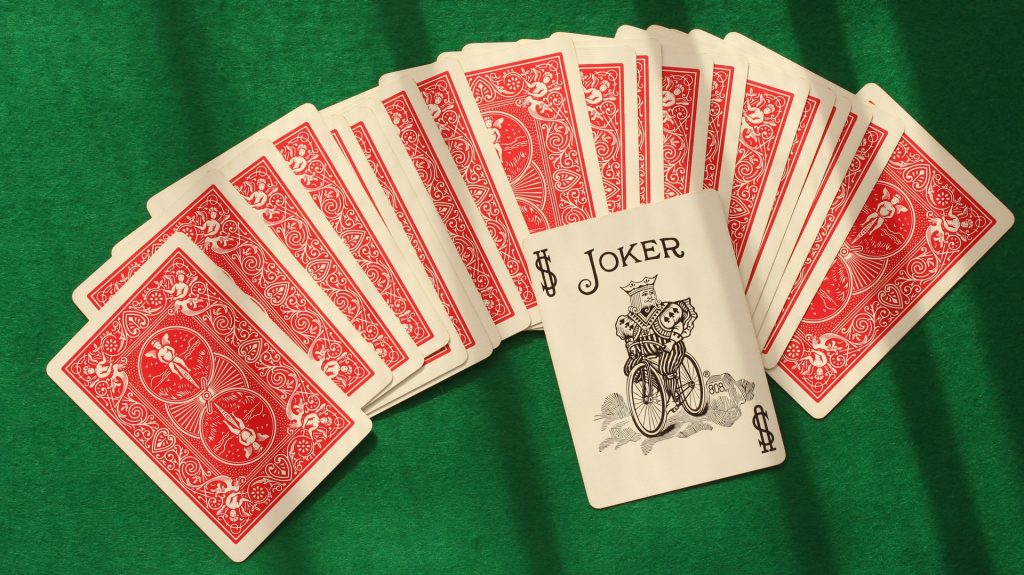
Did you know? Secret coded playing cards helped Allied prisoners of war to escape during WWII!
One of the most iconic playing card manufacturers is the Bicycle brand, created by the U.S. Playing Card Company. During World War II this company teamed up with British Intelligence to send troops and PoWs secret maps hidden within decks of playing cards. The cards could be split open when wet, revealing papers that could be pieced together to create a full-size map. The secret playing cards helped at least 32 people escape from Colditz Castle!
Did you know? Card collecting is a popular hobby, with rare decks and special individual cards fetching large sums at auction. A mid-15th century deck of Tarot cards from the Netherlands was considered to be the rarest and oldest, and now resides in New York City’s Museum of Modern Art.
