
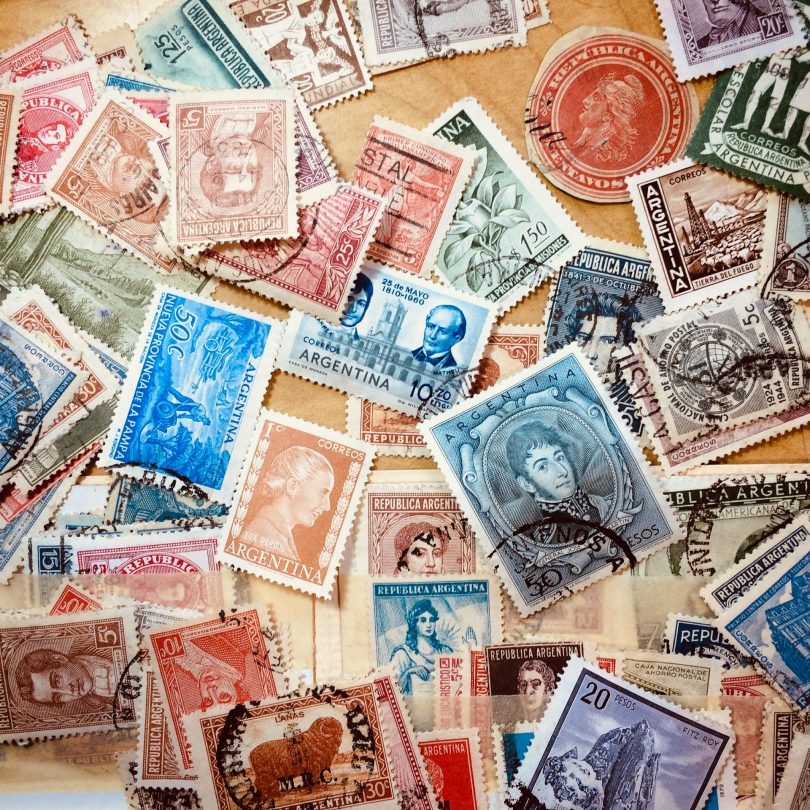

Collecting is currently all the rage, whether its comic books, Pokémon cards, NFTs, or Happy Meal toys. All of these hobbies owe something to Philately, or stamp collecting as it is more commonly known.
Collecting is an age-old obsession hard-wired into the human brain. But historians have suggested that modern collecting hobbies emerged in the second half of the nineteenth century, as the rise of industrial capitalism led to increases in leisure time and commodity production. In basic terms, people had more time to devote to their hobbies, and a wider choice of ‘things’ to collect! Colourful, diverse, and educational, stamps were some of the earliest items to inspire collectors.
The hobby of Kings, Queens, and Commoners alike, stamp collecting is the original and enduring collecting craze. Stamps tell a unique story of history and popular culture around the world, and it is no wonder that the hobby has recruited new fans in every generation ever since the Penny Black – the world’s first adhesive postage stamp issued in 1840! Today, stamp collecting is providing its community of enthusiasts with an antidote to the chaos of a world dominated by technology and social media. And this article will invite you to join them…
Read on for everything you ever wanted to know about stamp collecting!
Let’s begin by taking a look at the benefits of stamp collecting. Here are 6 reasons to start your own collection:
1. Learn!
Stamps are a powerful teaching tool for young children and curious minds of all ages.
For younger collectors, stamps can help build organisational skills and numeracy, as children categorize their collections and understand their items in new ways.
Every stamp has a story to tell. Which country issued the stamp? Can you find it on a globe? Does the country still exist? What does their flag look like? Ask your young collectors these questions and watch them become geography whizz kids!
With such a wide range of different types, stamps can teach collectors about world history, famous events, languages, currencies, historical figures, landmarks, mythology, animals, sports, music, art, popular culture, and much more. The possibilities are endless, and there are no rules – the collector is in the driving seat to direct their own educational journey!
2. Develop Patience and Focus
Stamp collecting can have important cognitive benefits, according to Miranda Goodman-Wilson, Assistant Professor of Psychology at Eckerd College in St. Petersburg, Florida. Sorting through stamps and building a collection rewards patience and deep focus, and requires “a very different kind of attention” than television or video games. The tiny details on a colourful stamp draws children in and helps slow down their racing minds. “When you’re looking at stamps, you spend a little more time than in our instant-gratification activities,” says Gretchen Moody, Director of Education at the American Philatelic Society. For stamp collectors, screen time is optional – divert your eyes back to something tangible!
3. Discover Art
With their beautiful designs on the smallest of canvases, stamps will introduce children to the wonders of art and graphic design. They also offer an opportunity for kids to get creative themselves. Try decorating an envelope with colourful stamps, then post your creation to friends or family.
4. Experience the Thrill of the Chase
Become a treasure hunter as a stamp collector, searching for rare stamps at car boot sales, antique shops, or in your attic! Fun for children and adults alike, and a chance to share some unforgettable moments of new discoveries!
5. Start a Collection for Free!
You could start a stamp collection at no cost by collecting stamps from your post. Purchase some stamps at your local post office, ask relatives to save them for you, or find a stamp shop or dealer in your local area.
Compared to most modern crazes, stamps are cheap to buy. Traditional hobbies like crocheting, baking, jigsaw puzzles, and stamp collecting are making a comeback, and they promise to be far kinder to the piggy bank than video games!
How do you remove a stamp from an envelope?
If you’re collecting used stamps, you’ll need to know how to get the stamps off the envelopes without harming them. The Smithsonian National Postal Museum provides a handy guide on the Chubb website:
- Tear or cut the envelope around the stamp, leaving a small margin.
- Soak the stamp, face down, for a 15-20 minutes in cool water.
- Once the stamp floats free, remove it from the water using stamp tongs, dry it between paper towels and put a heavy book on it for a day, so it doesn’t curl.
6. Connect
Although it is mostly an individual hobby, stamp collecting is all about community – comparing notes, sharing knowledge, trading, and assisting each other in the pursuit of those elusive stamps that would take a collection to the next level.
Stamps enable you to send a letter to any place on earth, even the most far-away and isolated! Post brings us closer together, and stamp collecting does the same job for its community of enthusiasts. Once you begin your collection you will be joining a community of millions of collectors from around the world, all bonded over a shared interest.
Stamps also provide opportunities for children to connect with their family. Stamp collections are often passed down from grandparents or parents, transmitting the passion for collecting while spending some quality time leafing through the pages together.

Themes
A great way to get started with stamp collecting is to pick a theme that captures your interest. Whether it is a particular time period, country, or subject, there is something to ignite the collecting passion of anyone! Here are some popular examples:
- Animals
- Cars
- Birds
- Butterflies
- Insects
- Flowers
- Sports
- Art
- Maps
- Scouting
- Olympic Games
- Ships
- Space
- Disney
- Chess
- Celebrities
- Christmas
- James Bond
- National Parks
- Wars
- Only Fools and Horses
- Harry Potter
- Star Trek
Stamp specialist Dominic Savastano emphasises the importance of the visual appeal of your collection. “Stamp collecting is very much an aesthetic hobby,” he said. “You buy stamps because you want to enjoy looking at them.”
Find a theme that looks great and sparks your interest. If you build your collection around something you’re passionate about, you’ll soon become an expert in your chosen subject.
Celebrities
The list of celebrity stamp collectors past and present is as long as it is diverse, and includes:
- Queen Elizabeth II
- Russian tennis player Maria Sharapova
- Former French President Nicolas Sarkozy
- Rolling Stone guitarist Ronnie Wood
- Actor and politician Arnold Schwarzenegger
- Queen singer Freddie Mercury
- Franklin D. Roosevelt
- John F. Kennedy
- John Lennon
The British Royal Family is thought to own the world’s most valuable stamp collection, worth over £100 million! Much of it was gathered and curated by George V in the late nineteenth century. The former King-Emperor wrote about his passion for stamp collecting to a correspondent: “It is one of the greatest pleasures of my life.”
Stamp collecting really is “The Hobby of Kings” – other collectors through the ages have included Ferdinand I of Bulgaria, King Carol II of Romania, King Farouk I of Egypt, Prince Rainier III of Monaco, and Princess Maha Chakri Sirindhorn of Thailand.
Dealers
The biggest publishing houses around the world release catalogues surveying the stamps of their respective nations. Stanley Gibbons is THE authority on stamp collecting in the UK, and dates back to its Plymouth-based Victorian founder Edward Stanley Gibbons.
The Scott catalogue is the US equivalent, founded by nineteenth century New York dealer John Walter Scott. In France the catalogue is published by Yvert and Tellier, while Germany’s premier company is called Michel.

The world’s rarest (and most valuable!) stamps
1. British Guiana 1-cent Magenta, 1856
Sold at auction for $9,480,000 in June 2014, this stamp has broken the world record for a single stamp sale price on each of the last four occasions that it has been sold.
Why makes it special? In 1856 there was a major stamp shortage in the colony of British Guiana due to a delayed ship bringing them from London. A local postmaster requested the creation of temporary stamps, and 3 different types were made according to his orders:
- 4-cent stamp in blue
- 1-cent stamp in magenta
- 4-cent stamp in magenta
The famous British Guiana 1-cent Magenta is thought to be the only stamp of its kind still in existence. Featuring an image of a sailing ship and an inscription of the colony’s Latin motto, the octagon-shaped stamp was discovered by a 12-year-old Scottish boy in the attic of his home in South America in 1973. It had once belonged to pioneering philatelist Philipp von Ferrary (1850-1917), whose collection is considered the greatest of all time. Due to go to auction once again in June 2021, the stamp is expected to fetch between $10 million – $15 million, more than 1 billion times its original value!
2. The Penny Black, 1840
Depicting Queen Victoria against a black background, the Penny Black was the first adhesive postage stamp in the world.
Over 68 million copies of the inaugural stamp were printed, so it is by no means a rare stamp. But mint condition versions with neat margins can command high prices. One set of four unused 1840 stamps was recently auctioned for $200,000, while used versions sell for over $1,000. The only known complete sheets are held at the British Postal Museum, and are valued at $5 million.
A reported 68,808,000 copies of the stamp were printed, meaning the Penny Black is not a rare stamp. However, examples in mint condition and with neat margins can command very high prices. The only known complete sheets are owned by the British Postal Museum. Penny Blacks can be highly collectible, with one set of four unused 1840 stamps available on the market for a whopping £140,000, while used versions can still sell for around £870.
3. Benjamin Franklin Z Grill, 1867
Issued by the United States Postal Service in February 1868, this 1-cent postage stamp depicting Benjamin Franklin is distinguished by a Z-shaped grill pressed into the stamp, leaving tiny indentations in the paper. Grilling was designed to prevent the illegal reuse of stamps, but was only used temporarily.
There are currently only two known versions of this stamp – one held at the New York Public Library, the other in a private collection, with a valuation of almost $3 million.
4. The Treskilling Yellow, 1855
This Swedish postage stamp is another item so rare that only one example is known to exist.
Issued the year of Sweden’s first ever postage stamps and featuring the country’s coat of arms, this stamp was mistakenly printed in yellow rather than its usual green colour. This printing error made the stamp exceptionally rare.
The error went unnoticed until young stamp collector Georg Wilhelm Bachman identified a special yellow-coloured stamp in his grandmother’s attic in 1886 – his discovery caused a sensation in the stamp collecting world.
The exact quantity of these misprinted stamps is unknown, but many believe that the Treskilling Yellow is a one-of-a-kind!
Having passed through several collections, including that of King Carol II, the stamp is currently owned by Swedish aristocrat and politician Count Gustaf Douglas. Its last sale price, at auction in May 2013, was $2.3 million.
5. The Sicilian Error of Colour, 1859
Another misprint, the stamp was mistakenly produced in dark blue rather than the intended yellow.
Today, only two copies of the 1859 Sicilian colour error are known to exist. One of them reached $2.6 million at auction in June 2011.
Depicting King Ferdinand II of the Two Sicilies on the year of his death, just prior to the foundation of modern Italy, the stamp represents an important moment in European history.
6. The 24c Inverted Jenny, 1918
The most famous stamp in the United States, the Inverted Jenny refers to a printing error on an edition of the original airmail stamp causing the plane to appear upside down. One hundred examples passed through the printers, and are highly prized by collectors. Normal copies sell for at least $100,000 today, while mint condition versions can fetch over $1 million.
7. The Whole Country is Red, 1968
This 1968 Chinese stamp from the Cultural Revolution is one of only nine copies.
The design features a large group of citizens, with a central figure holding the “Little Red Book” aloft. Communist slogans in the background read “Long live the total victory of the Cultural Revolution without the bourgeoisie”. For history buffs, this stamp represents the propaganda efforts of Chairman Mao and his political revolution in China.
Although mainland China is coloured in red, the island of Taiwan is left in white, reflecting a printing mistake that makes this stamp highly rare and valuable. One was sold for almost $450,000 at auction in July 2015.

Digital and the Future
Philately is beginning to embrace digital platforms, opening up new opportunities for collectors and making the hobby more accessible than ever before. A growing online community of enthusiasts is creating an exciting future for the traditional pastime, and there is a wide range of resources for new recruits to learn, connect, and share.
Blogs are ideal for stamp collecting, chronicling the personal collecting journeys of their authors, and two of the best are The Punk Philatelist blog and Mail Adventures.
The stamp collecting community is international, and online platforms provide new opportunities to connect philatelists from around the world. Reddit hosts an expanding community of enthusiasts. The r/philately group, “A place to discuss stamps and postal history with fellow collectors,” now has well over 5k active members. Popular internet forums include the Stamp Forum (TSF), the Stamp Community Forum, and Stamp Boards.
Exploring Stamps, sponsored by the American Philatetic Society via Stamps.Org, is establishing a stamp collecting community on YouTube, with over 20,000 subscribers enjoying a regular stream of quality content.
Instagram is big in the philatelist community, with the visual appeal of stamps lending itself well to the image sharing platform. Popular accounts include the American Philatelic Society, the Royal Mail, Stanley Gibbons, the Enfield Post, and Patrick Dea’s Edelweiss Post, which also has an Etsy shop.
Some of the biggest stamp collecting Twitter accounts include @Philatelovely and @LinnsStampNews, the Twitter arm of the largest weekly stamp collecting magazine. The Amateur Philatelist Facebook group provides another online home to stamp collectors.
For new hobbyists, websites created by Stanley Gibbons and Chubb provide comprehensive guides to getting started.
Conclusion
Stamps were once a vital part of the economy, connecting people around the world like never before through the development of an international postage system. Their beautiful miniature designs and educational content, informing people about far-off places before radio, television, or air travel, made them an instant hit with collectors. Email and instant messaging platforms may have rendered the stamp slightly less important, but they have lost none of their charm for philatelists.
Stamp collecting is a wholesome and entertaining hobby that is evolving to reach new audiences in new communities, with philately increasingly popular in China, Hong Kong, Japan, and India. Give it a try – you never know where a little stamp might take you!