
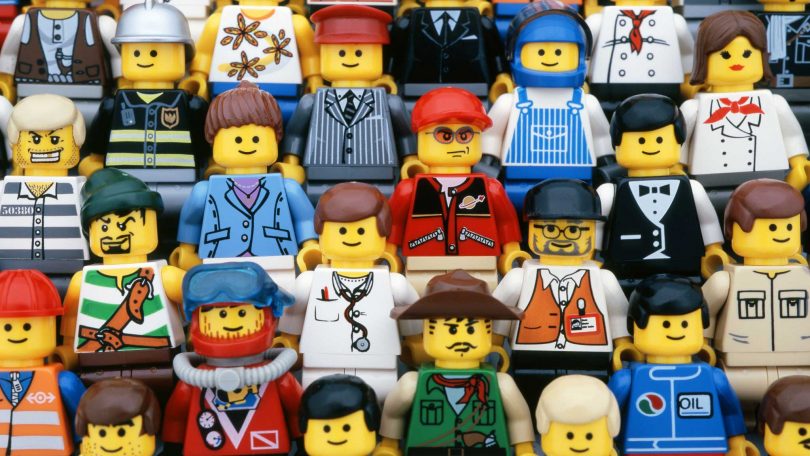

LEGO: the world’s best-loved and most valuable toy brand.
Since its launch in 1949 LEGO’s interlocking toy bricks have provided the building blocks of creative play for children across the world.
Having begun in an independent toymaker’s workshop in the small Danish town of Billund, LEGO is now the most powerful international brand, having recently placed top of a ranking of the world’s most reputable companies for the fourth year in a row1.
Today there are LEGO films, videogames, and theme parks, but the most important part of the brand remains the simple LEGO brick, with its carefully designed studs and tubes that enable bricks of all sets to connect firmly together.
LEGO stimulates creativity. Award-winning architect Bjarke Ingels, designer of the new LEGO House in Billund, recently celebrated the unique way in which LEGO provides concrete materials for children to give life to their abstract ideas. “What I love about LEGO is that LEGO is not a toy but a tool that empowers the child to build his or her own world, and then to inhabit that world through play, and to invite her friends to join her in co-inhabiting and co-creating that world.”
LEGO builders learn while they play, developing problem solving skills as they learn how to plan, quantify, and construct.
LEGO and the Plastic Crisis
Despite the worldwide love for the LEGO brand, the company has recently drawn criticism for the environmental impact of its famous plastic bricks.
LEGO bricks have formed part of the plastic garbage patch accumulated in the world’s oceans.
Beachcombers continue to find LEGO pieces from a cargo ship called the Tokio Express that was hit by a freak wave off the coast of Cornwall in 1997, spilling 62 containers into the sea, including one filled with almost 5 million pieces of LEGO. An online community dedicated to chronicling the “Lego Lost At Sea” has grown to over 50,000 followers.
LEGO has come under the spotlight as the sustainability agenda has grown in importance and global awareness. The company’s significant carbon footprint and plastic waste have caused significant concern, but the most pressing issue is the impact of LEGO bricks on marine environments, adding to the plastic polluting the oceans.
But the company has taken the initiative, developing ambitious and innovative strategies to transform their bricks, reduce their carbon footprint, and create a brighter and greener world for the next generation. LEGO is on a mission: to inspire children to become the builders of a more sustainable future.
Bio Bricks
By 2030, LEGO wants to make all its bricks from sustainable sources – materials that are produced responsibly using renewable or recycled resources, generating little or no waste in their production while meeting the company’s high standards for safety, quality, and durability.
This ambitious goal will require the creation of entirely new materials, and LEGO is working with researchers and suppliers to develop the bricks of the future.
Since 2018 LEGO has made its botanical elements, like leaves, bushes, and trees, from plant-based materials. It uses sugarcane grown in sustainable cycles to create polyethylene, a soft, durable and flexible plastic. More than 80 LEGO elements are currently made from the new material, around 2% of the total stock. This might not sound a lot, but it is the first important step on the path towards sustainable LEGO bio bricks!
The LEGO Ideas Treehouse, based on a concept created by a fan, contains 185 sustainable bricks, making it the most sustainable LEGO set to date.
All leaves and plants in the new LEGO Ideas Treehouse are made from plant-based plastic, 185 out of the 3036 elements, that’s six percent of the total elements in the product, the largest number of plant-based elements used in a LEGO product so far.
The company has begun making Lego plants and other elements from plant-based material – from sugar cane grown in sustainable cycles. Used in the LEGO treehouse – the set with the most sustainably sourced elements to date
Since we launched plant-based bricks, they have been included in more and more LEGO sets. For example, the LEGO Ideas Tree House, a concept devised by a LEGO fan, contains 185 sustainable bricks including the treetop canopy, which has interchangeable sets of green summer leaf elements and yellow and brown fall leaf elements.
The leaves and branches that form the treetop canopy are all made from the sugarcane material, making LEGO plants from real plants, and demonstrating that LEGO bricks can be grown from the earth!
Removing Plastic from Packaging
As well as the LEGO bricks, the company is also designing more sustainable packaging.
From 2021 the plastic bags containing the bricks in LEGO sets will be swapped for paper bags, as the company attempt to reduce its production of single-use disposable plastic.
The paper bags will be fully recyclable, using sustainably sourced paper and cardboard certified by the Forest Stewardship Council. They will be designed to help children understand the importance of recycling.
Today, approximately 75% of the cardboard used to make LEGO boxes comes from recycled material.
LEGO aims to make all of its packaging sustainable by 2025.
The LEGO Replay Programme
Reducing waste is another priority for LEGO’s sustainability mission, and the LEGO Replay Programme is a new initiative designed to help them achieve their goals.
The adaptability of LEGO makes it ideal for recycling, and LEGO Replay encourages children to donate their pre-loved LEGO sets and pre-used bricks to be reused in schools and in under-privileged communities.
The scheme is already available in the USA and Canada, and LEGO plans to expand to other countries in the next few years. So far, over 136,078 kilograms of LEGO bricks have been donated, and 42,350 children are playing with LEGO Replay bricks.
Reducing the Carbon Footprint
LEGO has already made significant progress in reducing its carbon footprint.
In 2013 the company partnered with the WWF, becoming the first toy brand to join the WWF Climate Savers programme.
LEGO planned to make its energy consumption 100% balanced by renewable energy by 2020, and achieved its goal early, by 2017, thanks to a large investment in wind farms.
Building a Better World
LEGO has made clear its commitment to environmental causes for many years. In 2014 LEGO cancelled its contract with Shell under pressure from Greenpeace International, who protested Shell’s plans to drill for oil in the Arctic.
Having achieved significant progress in reducing its carbon footprint, the company is now focused on transforming the famous plastic LEGO brick, creating a sustainable brick of the future from cutting-edge materials.
As LEGO adapts and evolves, the world’s best loved brand promises to stimulating the creativity of young LEGO builders for generations to come.
1Lucy Handley, ‘Lego is the world’s most reputable company as tech giants lag, survey says’, CNBC: https://www.cnbc.com/2020/03/03/lego-is-the-worlds-most-reputable-company-disney-follows.html#:~:text=Lego%20has%20topped%20a%20list,10%20every%20year%20since%202011.
